International
What is the Indo-Pacific Economic Framework for Prosperity (IPEF)?
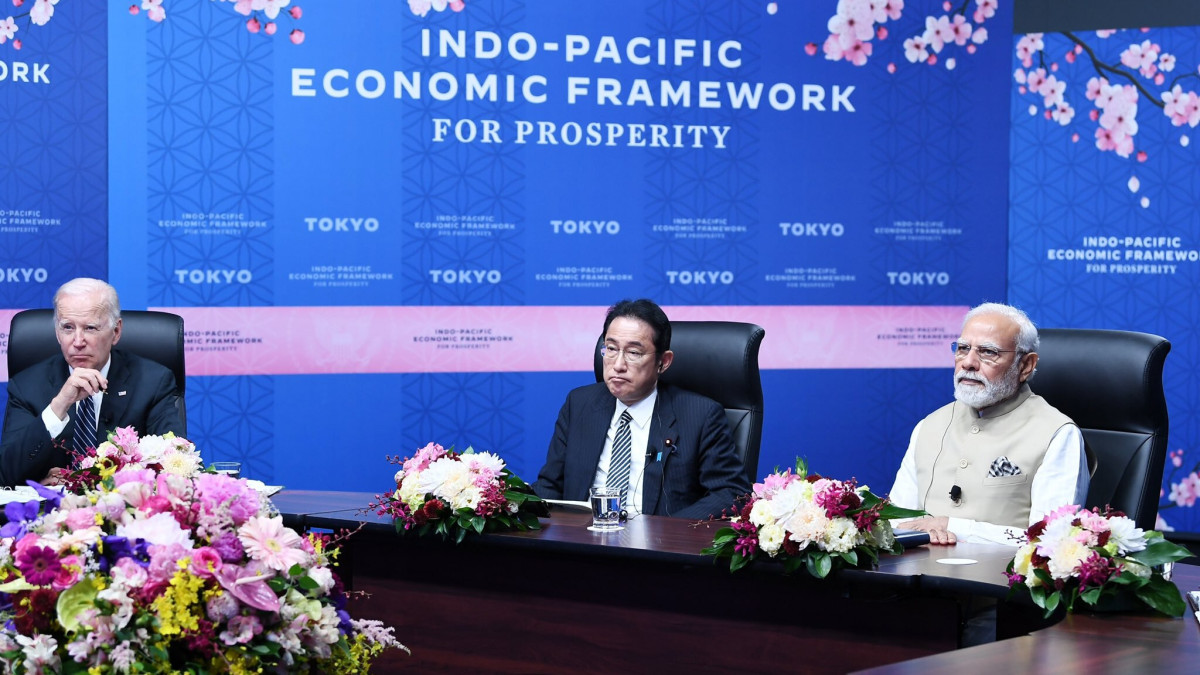
Indo-Pacific Economic Framework (IPEF) was launched by the US in 2022 as a significant step towards establishing free and fair trade with the nations of the Indo-Pacific region. Presently, there are 13 member countries in this framework including India which account for 40% of the global GDP and 28% of the global trade.
Through this initiative, the IPEF partners aim to contribute to cooperation capability, prosperity, development, and peace within the region. Moreover, it is aiming towards advancing resilience, sustainability, inclusiveness, economic growth, fairness, and competitiveness in the economies.
The IPEF broadly rests on four pillars: trade, supply chain resilience, clean energy and decarbonization, and taxes and anti-corruption measures.
IPEF is designed to be flexible, meaning that IPEF partners are not required to join all four pillars.
Through Trade Pillar negotiations, the United States seeks to build high-standard, inclusive, free, and fair-trade commitments and to develop new, creative, and economically meaningful approaches to trade policy in the Indo-Pacific region.
IPEF is likely to work towards advancing the trade policy goals of resilience, sustainability, and inclusivity by negotiating commitments in the following areas: labor, environment, digital economy, agriculture, transparency and good regulatory practices, competition policy, trade facilitation, inclusivity, and technical and economic cooperation.
India agreed with the conclusion and text on three of the four pillars which were - supply chains, tax and anti-corruption, and clean energy and joined the declaration. But, India decided to stay away from the Trade Pillar.
India pulled out of the IPEF’s trade pillar-related negotiations in September last year, citing it was unclear what benefits member countries, including India, would derive from the negotiations. As a result, India decided to wait for the final contours and chose to be an observer.
But, India, with just being an observer, has not been able to access the negotiation rounds regarding the trade pillar that kickstarted.
There have been a lot of discussions about whether India should join the Trade pillar now and participate in negotiations or contemplate joining it later when negotiations are concluded and accept what will be offered.
About author

Zinkpot — We Inform, You Perform.
Ask Anything, Know Better
अपना प्रश्न पूछें
-
What is the SOSA Agreement between USA and India?
November 14 Background The SOSA Agreement is a new defense deal between India and the United States, signed in August 2024. Its main purpose is to help both countries get important military supplies quickly during emergencies. This agreement makes their defense partnership stronger and ensures that weapons, equipment, and other essential items can reach on time when needed. SOSA builds on many earlier India–US military agreements and is another step forward in their growing strategic cooperation. What Is the SOSA Agreement? SOSA...
-
What is the G2?
November 05 Background The G2 is a simple idea in world politics. It stands for "Group of Two." It means the United States (US) and China working together as the two biggest powers on Earth. They could team up to solve big global problems like climate change, trade, or wars. But it's not an official group like the United Nations. It's just a way to think about how these two countries can shape the world. The History of the G2 Idea The G2 idea started around 2009. Back then, the world was facing a big money crisis....
-
What Is ASIA PACIFIC ECO COOPERATION (APEC)?
November 04 What is APEC? APEC is more like a forum where countries meet to share ideas and agree on ways to help each other. The main goal is to create more jobs and better lives for people in the Asia-Pacific area by making trade free and fair.It started with the idea that if countries trade more openly, everyone wins. APEC helps reduce taxes on goods (tariffs), make rules simpler for businesses, and share new tech. It's all about "cooperation" – working together for everyone's good. History of APEC APEC...
-
The Longest U.S. Government Shutdown: Why It Matters for India?
October 25 Background What is a US government shutdown? click here Context The United States has had many government shutdowns over the years when leaders can't agree on spending money. The longest one happened from December 22, 2018, to January 25, 2019. It lasted 35 days and affected millions of people. This shutdown was during President Donald Trump's time and was about funding for a border wall. Today, there's an ongoing shutdown that started on October 1, 2025, and it's already the second-longest at over 23 days. But...
-
China की Monopoly तोड़ने निकला अमेरिका !
October 22
-
Difference between FTA and BTA in trade
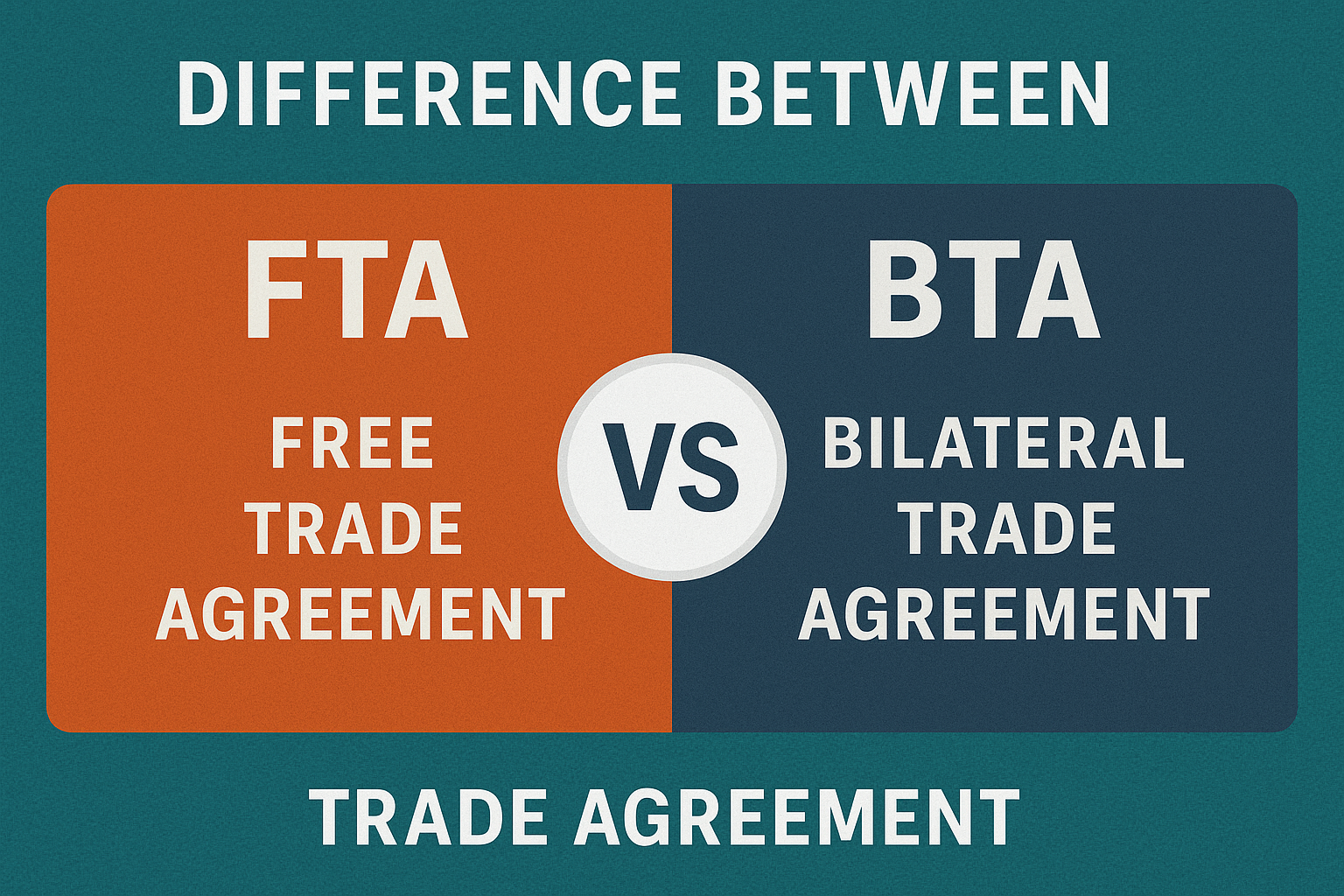
July 23 WHAT? The terms Free Trade Agreement (FTA) and Bilateral Trade Agreement (BTA) are often used in the context of international trade, but they have distinct meanings and implications. Below is a clear explanation of the differences based on their definitions, scope, and application. Free Trade Agreement (FTA) An FTA is a treaty between two or more countries to reduce or eliminate trade barriers, such as tariffs and quotas, to facilitate the free flow of goods and services. FTAs aim to create a free trade...
-
Trump threatens 10% tariff on BRICS nations
July 07 WHAT? U.S. President Donald Trump has threatened to impose an additional 10% tariff on countries aligning with what he describes as the "anti-American policies" of the BRICS nations. This statement, made via a post on Truth Social on July 6, 2025, comes amid the ongoing 17th BRICS Summit in Rio de Janeiro, Brazil, and signals heightened trade tensions. Key Details Tariff Threat: Trump stated, "Any Country aligning themselves with the Anti-American policies of BRICS, will be charged an...
-
USA का नया Bill: भारत-चीन पर 500% टैक्स की तैयारी!
July 06
-
B-2 Bombers हवा में Refuel कैसे करते हैं?
June 26
-
What can IRAN do against the USA?
June 24
Comments
Write Comment