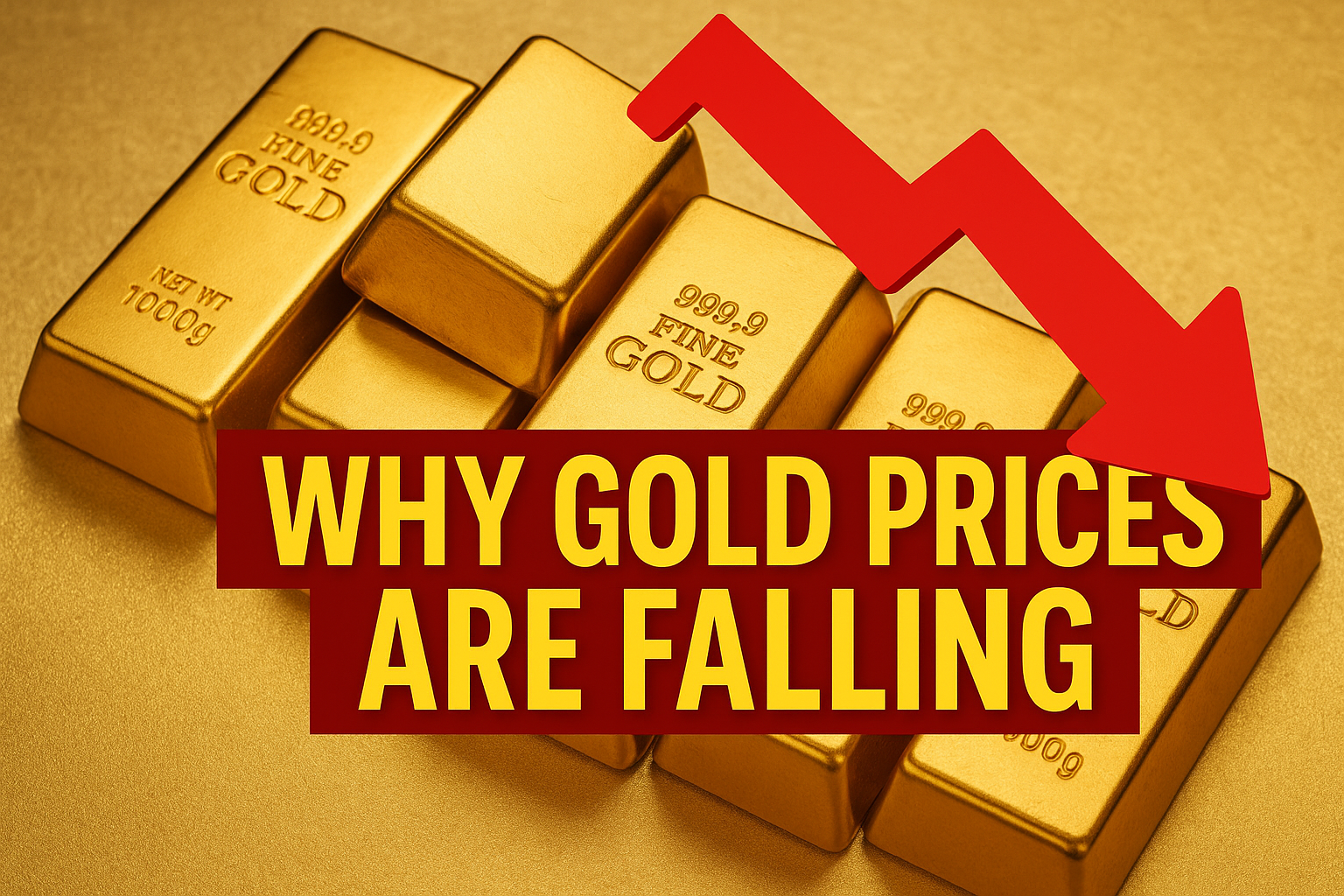
Inflation, Monetary Policy and RBI
Why are Gold prices falling now?
Gold has been seen as one of the most preferred mode of investment and it's prices have been volatile. Few months ago, it's prices were rising and now they are falling due to a combination of macroeconomic, financial, and geopolitical factors. Let's have a look at them.
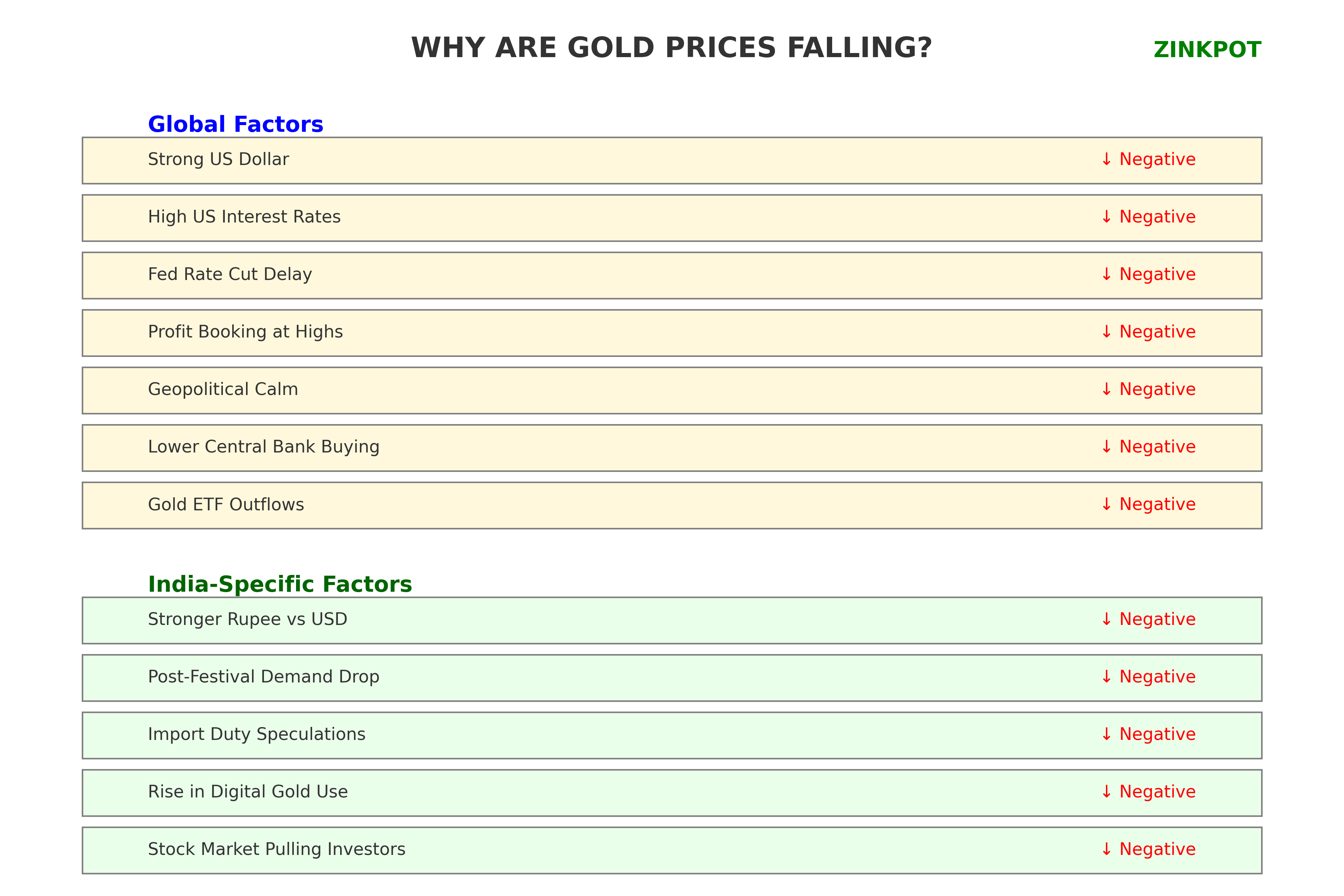
Strengthening of the US Dollar
Gold is priced in US dollars globally. When the dollar strengthens gold becomes more expensive in other currencies, reducing international demand. This puts downward pressure on gold prices.
In recent times, the US Dollar Index (DXY) has been rising due to strong US economic data. This made gold very costly and reduced it’s demand subsequently, moderating it’s prices.
High US Interest Rates
The US Federal Reserve has maintained high interest rates so that people borrow less and inflation reduces. When the central bank like the US Fed or India’s RBI increase the interest rates, the borrowers like Governments or corporations find it costly to borrow from the banks and issue bonds at attractive interest rates to attract investors money. This makes bonds ore attractive than gold and investors shift funds from gold to bonds or savings instruments for better returns.
Profit Booking After Gold Hit Record Highs
Recently Gold reached record highs in early April 2025 to 95000 per 10 gms. Many investors booked profits, triggering a correction. The selling pressure from institutional and retail traders caused prices to fall.
Reduced Geopolitical Risk Premium
Gold is a safe-haven asset during crises. Recent de-escalation in Middle East tensions, the chances of truce between Russia and Ukraine and no major new global conflicts have led to lower demand for safe assets. This has diminished the "fear premium" that supports high gold prices.
Bull run in Equity Markets and ETF Outflows
In the last 5-6 months, particularly in India, the stock market was very volatile which led investors to park a large amount in gold. Now since the companies performance data is encouraging, the charm in the equity market is back and investors have returned to the stock. This has reduced demand for gold and also Gold ETFs (Exchange-Traded Funds) saw net outflows in recent weeks.
A tabular summary of causes and effects is below
About author

Zinkpot — We Inform, You Perform.
Ask Anything, Know Better
अपना प्रश्न पूछें
-
Is the Dollar’s Dominance Coming to an End?
November 19 What does the Dollar Dominance Mean? For nearly eight decades, the U.S. dollar (USD) has been the world’s reserve currency and has been used for Global trade and oil payments (the “petrodollar” system) Central bank reserves International loans and debt Safe-haven investment in crises The dollar has been the backbone of the global financial system. About 58–60% of all global foreign exchange reserves are still held in dollars (IMF, 2025). How did the Dollar become...
-
Gold prices surge by Rs 1,200/10g, and the rally may not be over yet. Here’s why it may be time to accumulate
November 10 ET : Gold prices traded sharply higher on Monday, with the MCX December futures jumping over 1% or by Rs 1,223 to Rs 1,22,290 per 10 grams, amid renewed safe-haven demand following weak U.S. consumer sentiment data and a soft jobs report. NEWS LINK
-
Different rates of FDs by Indian banks for Senior citizens
October 24 Before locking your money into a fixed deposit (FD), it’s essential to compare interest rates across banks. Returns vary widely depending on the institution and the tenure. In most cases, banks offer better returns for longer durations and senior citizens often receive additional interest too. Senior citizens frequently receive a higher rate (often 0.25–0.50% more) than general depositors. Lets have a look at some attractive offers. (Rates as of October 2025) Small Finance Banks (Offer the Highest FD...
-
INDIA'S GOLD RUSH! इतना की सबके पास ₹2.25 लाख!
October 13
-
Nepal, Bhutan and Srilanka to get loans in INR? Rupee going international?
October 03 What RBI Is Allowing? As of October 2025, RBI has decided that Authorised Dealer (AD) banks in India and their overseas branches can extend rupee-denominated loans to residents and institutions in Bhutan, Nepal, and Sri Lanka for trade-related transactions. Reserve Bank of India (RBI) has moved to allow loans in Indian rupees (INR) to neighbouring countries under certain conditions. This is part of a broader push to internationalize the rupee and deepen rupee-based trade and finance. The measure aims to facilitate...
-
RBI’s Bold Banking Reforms: Easier Loans, Stronger Banks, Global Rupee Push
October 03 What? In a landmark announcement that signals a new era for India's financial sector, the Reserve Bank of India (RBI) has unveiled a comprehensive package of banking reforms designed to simplify lending, fortify institutional resilience, and accelerate the internationalization of the Indian rupee. Described by experts as a "bold and forward-looking" overhaul, these measures come on the heels of the Monetary Policy Committee's (MPC) decision to maintain the repo rate at 6.50%, while shifting to a...
-
What are unclaimed deposits with Banks?
September 24 What Are Unclaimed Bank Deposits? Unclaimed deposits are balances lying in savings accounts, fixed deposits, recurring deposits, or other bank accounts that have had no customer activity for 10 years or more. After this period, banks are required to transfer these amounts to the Depositor Education and Awareness Fund (DEAF), maintained by the Reserve Bank of India (RBI). Importantly, these deposits are not forfeited. Depositors or their legal heirs can still claim the money at any time through the bank, which then seeks...
-
Why is FSDC a guardian of India's financial health?
September 08 WHAT? The 2008 Global Financial Crisis exposed how fragmented regulation in banking, insurance, and capital markets can destabilize entire economies. Learning from this, the Government of India established the Financial Stability and Development Council (FSDC) in December 2010 to strengthen financial resilience and protect the economy from systemic shocks. The FSDC is a high-level, non-statutory body that brings all key financial regulators under one platform. In today’s era of global uncertainty—marked by...
-

About RBI's Consumer Confidence Survey
August 29 WHAT? Consumer confidence is an economic indicator that gauges how optimistic or pessimistic consumers feel about the economy and their personal financial situation. RBI's Consumer Confidence Survey (CCS) is conducted bi-monthly. RBI’s CCS assesses perceptions and outlook on key economic parameters such as the general economic situation, employment, income, prices, and spending behavior. It produces two key indices: Current Situation Index (CSI) – Measures consumer sentiment about the...
-
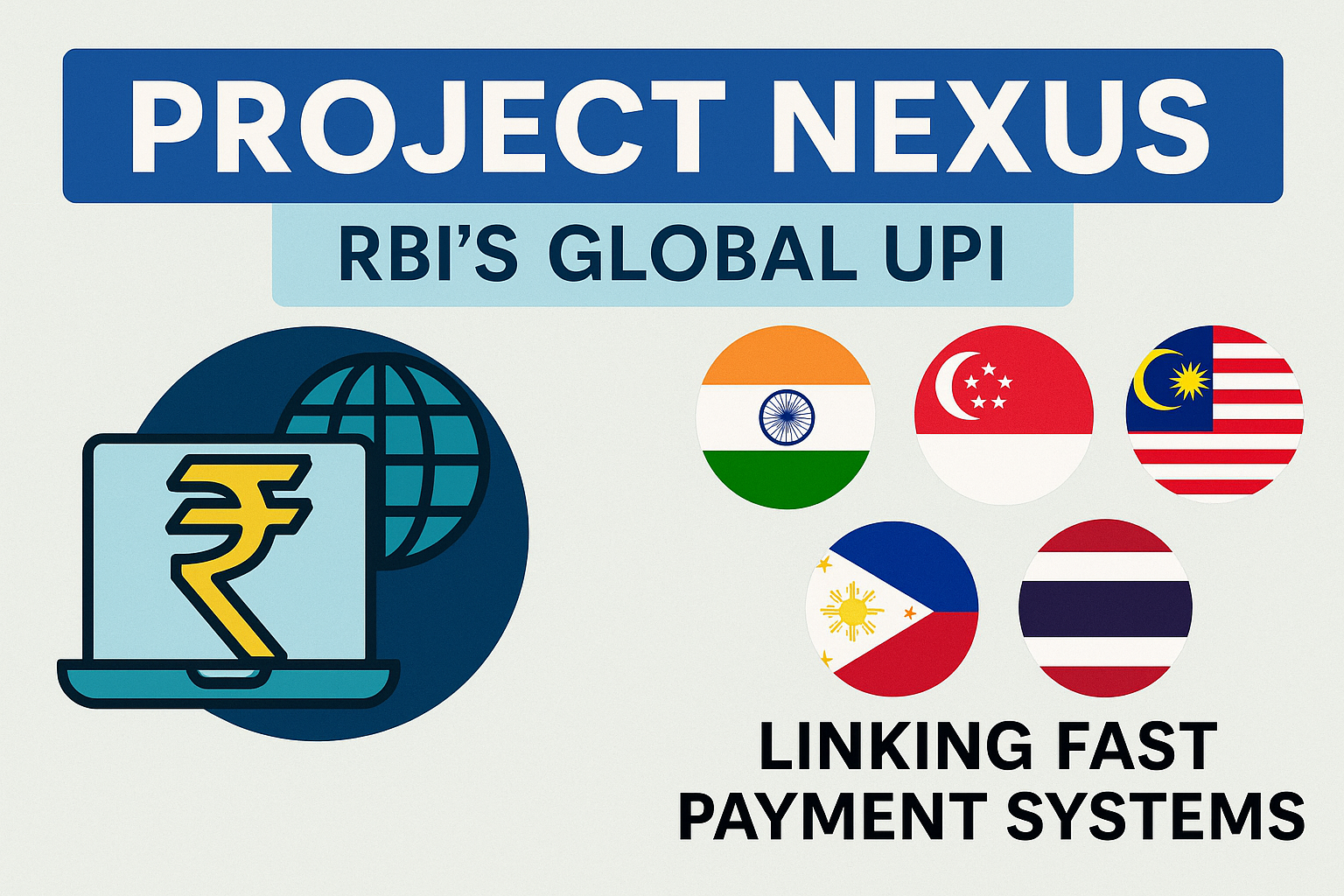
What is Project Nexus of RBI?
August 28 WHAT? Project Nexus is a multilateral initiative led by the Bank for International Settlements (BIS) Innovation Hub to create a standardized platform for connecting domestic instant payment systems (IPS) across countries, enabling seamless, instant cross-border retail payments. Launched in 2021, it addresses challenges in traditional cross-border payments, such as high costs, delays, and lack of transparency, by allowing IPS operators to make a single connection to the Nexus platform to access multiple...
Comments
Write Comment