CURRENT NEWS
State of the Economy. Why are GST collections soaring—and will it last?
SUMMARY
India's Goods and Services Tax (GST) collections have been on an upward trajectory, with April 2025 witnessing a record high of ₹2.37 lakh crore—a 12.6% year-on-year increase. This surge is attributed to several key factors:
Key Drivers of Rising GST Collections
-
Robust Import Activity: A significant 20.8% increase in GST revenue from imported goods, particularly high-value items like electronics and gold, has bolstered overall collections.
-
Enhanced Domestic Consumption: Domestic transactions contributed approximately ₹1.9 lakh crore, marking a 10.7% rise. This reflects strong consumer demand and economic activity within the country.
-
Improved Compliance Measures: The government's intensified efforts against tax evasion, including stricter audits and leveraging data analytics, have led to better compliance and higher tax revenues.
-
Inflationary Impact: Elevated retail prices have naturally increased the tax base, resulting in higher GST collections.
-
Increased Refund Issuance: April saw a 48.3% rise in GST refunds, amounting to ₹27,341 crore. While this indicates efficient processing, it also affects net revenue figures.
Sustainability of the Uptrend
While the current growth in GST collections is promising, its longevity depends on several factors:
-
Economic Stability: Continued economic growth and consumer spending are crucial for maintaining high GST revenues.
-
Policy Consistency: Sustained enforcement of compliance measures and avoidance of frequent rate changes will help in preserving revenue momentum.
-
Global Trade Dynamics: Fluctuations in global trade can impact import volumes, thereby affecting GST collections from imports.
In summary, the surge in GST collections is a positive indicator of India's economic health, driven by strong domestic consumption, increased imports, and improved compliance. However, maintaining this growth will require consistent policy implementation and monitoring of both domestic and global economic factors.
CLICK HERE FOR FULL NEWS
About author

Zinkpot — We Inform, You Perform.
Ask Anything, Know Better
अपना प्रश्न पूछें
-
CBDT Exposes ₹9,169 Crore Fake Political Donation Scam Involving Small Parties, Accountants, and Middlemen
November 10 Overview India's tax department has caught a big scam where people used fake donations to political parties to avoid paying taxes. The Central Board of Direct Taxes (CBDT) found out about a ₹9,169 crore racket. This involved small political parties, accountants, and middlemen who helped cheat the system. The news came out on November 9, 2025, and it's a wake-up call for how some people misuse rules meant for real political funding. Why CBDT Monitors Donations CBDT is the government body that handles income...
-
What Got Cheaper and Costlier After GST Rate Cut 2025?
September 22 GST Rate Reforms 2025: Overview India's Goods and Services Tax (GST) underwent its most significant overhaul since 2017 with the rollout of "GST 2.0" reforms, approved by the 56th GST Council meeting on September 3, 2025. Effective from September 22, 2025 (coinciding with the start of Navratri), these changes simplify the structure from four main slabs (5%, 12%, 18%, 28%) plus cess to a streamlined system: 0% (exemptions), 5%, 18%, and a new 40% slab for luxury and "sin" goods. Tobacco products like...
-
NEXT GEN-GST REFORMS! What are the major changes made in GST 2.0 in 2025?
September 05 Category / Examples Old GST New GST Notes Consumer durables – air-conditioners, dishwashers, TVs (LCD/LED) 28% 18% Rate rationalisation for electronics. Cement 28% 18% Relief for housing & infra. Small cars (≤1200cc petrol/LPG/CNG ≤4000 mm; ≤1500cc diesel ≤4000 mm) 28% 18% Relief for middle class Motorcycles ≤350 cc 28% 18% >350 cc moved to 40%. Three-wheelers (HSN...
-
How GST council's voting and decision takes place?
September 05 The GST Council is established under Article 279A, introduced by the 101st Constitutional Amendment Act, 2016. It functions as a joint forum for decision-making between the Union and the States. Members of GST council include: Union Finance Minister (Chairperson) Union Minister of State in charge of Revenue/Finance State Finance Ministers or their nominees Weighted Voting Structure Decisions are made through a weighted voting system, structured as follows: Central Government holds 1/3 (≈33.33%) of...
-
What GST reforms may include?
September 03 The GST Council, led by Finance Minister Nirmala Sitharaman, is advancing an extensive overhaul of the Goods and Services Tax system—arguably the most significant since its launch in 2017. Key highlights include Elimination of 12% and 28% slabs: These are being phased out in favor of a two-rate structure—5% for essential and "merit" goods and 18% for standard items. A 40% "sin and luxury" rate will initially remain for high-value goods like tobacco and premium automobiles. Benefits...
-
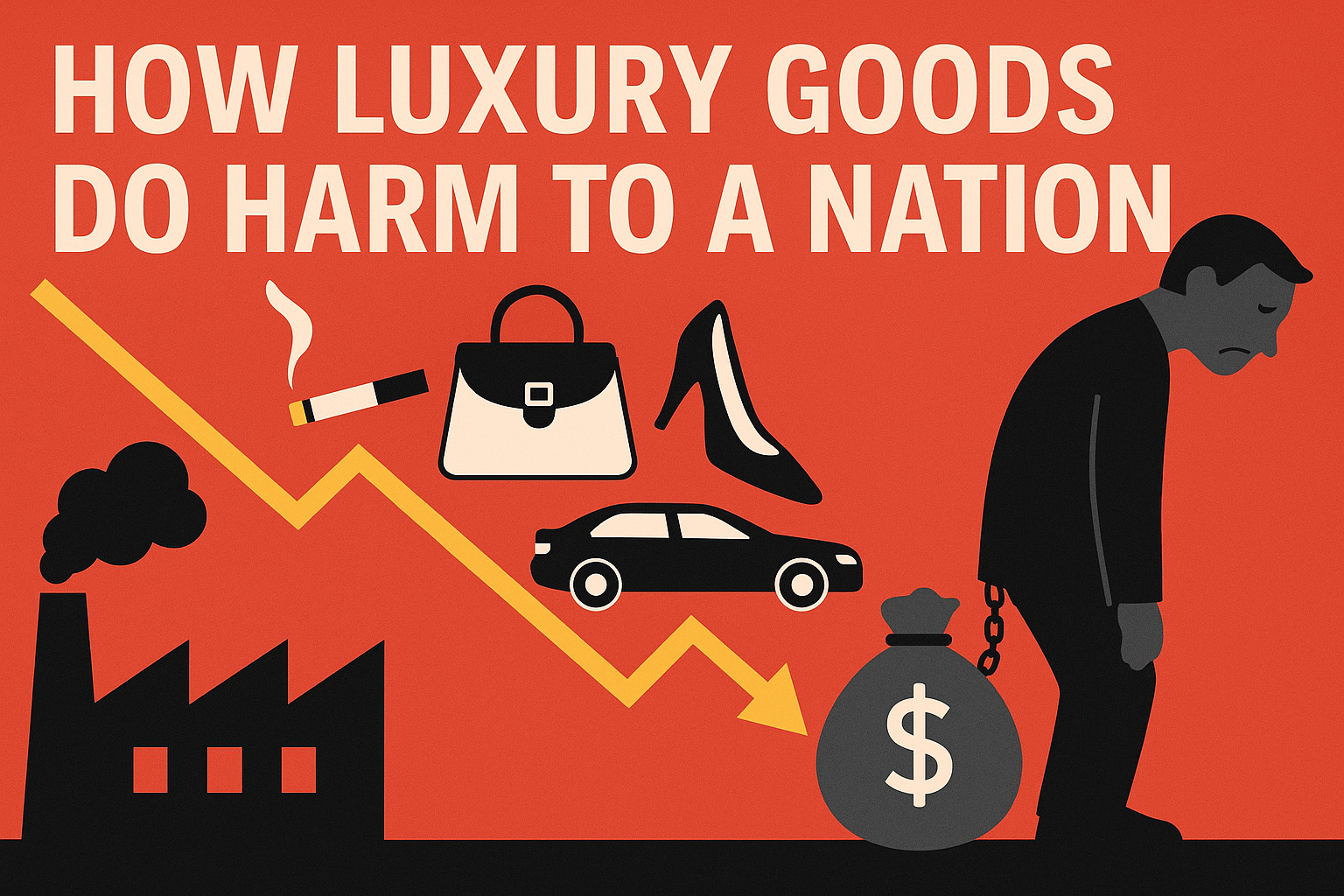
How Luxury Goods are Harmful for a Nation?
August 25 WHAT Luxury goods like expensive cars, branded clothes, diamonds, and imported wines are seen as a status symbol in today’s world. They may give happiness and prestige to individuals, but at the national level, they create economic pressure, social inequality, and cultural harm. Key Points and Analysis Issue Analysis Result 1. Dependence on Imports Most luxury goods are imported, sending foreign exchange abroad. Money drains out instead of building...
-
GST Rates change : How much cheaper your new car may become?
August 23 CONTEXT The government is planning to rationalize the GST rates. As of now the different rates are 0%, 5%, 12%, 18% and 28%. The cars attract a GST of 28% making them costlier. The government's Group of Ministers (GoM) are discussing potential changes to India's GST structure for vehicles, which could significantly reduce prices and make car ownership more affordable. They are backing a simplified two-slab GST system: 5% for essentials and 18% for standard items. This overhaul might lower GST on small cars and...
-
GST collection nearly doubles in 5 years
June 30 WHAT? India’s Goods and Services Tax (GST) collection nearly doubled over five years, reaching an all-time high of ₹22.08 lakh crore in FY25. This marks eight years since GST’s introduction on July 1, 2017, reflecting significant growth in the tax regime. Key Details Growth Trajectory: GST collections rose from ₹11.37 lakh crore in FY21 to ₹22.08 lakh crore in FY25, a year-on-year increase of 9.4%. The average monthly collection increased from ₹1.51 lakh crore in FY22 to ₹1.84...
-

What is Inverted Duty Structure (IDS)?
May 21 Inverted tax structure simply refers to a condition where the tax rate on import of inputs used is higher than the tax rate on the outputs or final products for sale or exports. Usually, tax policies promote domestic manufacturing and therefore imports of finished products are made costlier by applying custom duty or tax and import of it's raw materials or components is made cheaper. But the reverse occurs in the inverted duty structure. For example : Duty on the import of tyres (Finished...
-
What is an inheritance tax? Should India have such a tax?
April 24 Inheritance is acquisition of a person's property by the close family members after the person’s death. Inheritance tax would mean a tax to be paid by those who inherit property from their parents/grand parents or other relatives. Inheritance tax is also known as estate tax, is levied on the total value of money and property of a deceased person before it is distributed to their legal heirs. The tax is typically calculated based on the value of the assets left behind. The purpose of inheritance tax is often...
Comments
Write Comment