
External Sector
What are Currency Swap Agreements?
WHAT?
A currency swap involves two parties exchanging a specified amount of one currency for another at an agreed exchange rate, with a commitment to reverse the transaction at a future date, often at the same rate plus interest.
Currency swap agreements are financial arrangements between two central banks or monetary authorities to exchange their respective currencies up to a pre-agreed amount, typically to provide liquidity, stabilize exchange rates, or support trade and investment.
Swaps are typically short-term (e.g., 3-5 years) and can be renewed. They differ from loans as they involve an exchange rather than a direct transfer, with terms designed to minimize currency fluctuation risks.
PURPOSE BEHIND THE SWAP
- Liquidity Support: Provides access to foreign currency to stabilize domestic financial systems during crises (e.g., dollar shortages).
- Trade Facilitation: Enables payments in local currencies, reducing reliance on third-party currencies like the U.S. dollar.
- Reserve Management: Bolsters foreign exchange reserves without depleting cash holdings.
- Geopolitical Strategy: Signals trust and strengthens financial ties between nations.
India's Recent Currency Swap Agreements
India has actively pursued bilateral currency swap agreements to enhance financial stability, support regional trade, and reduce dependence on the U.S. dollar, aligning with global trends toward de-dollarization. Below are key examples from recent developments:
- India-Japan Bilateral Swap Arrangement (BSA): On February 28, 2025, the Reserve Bank of India (RBI) and the Bank of Japan renewed a $75 billion bilateral currency swap agreement, unchanged in size from its previous iteration. This two-way arrangement allows India and Japan to swap their local currencies (Indian Rupee and Japanese Yen) for U.S. dollars.
- India-Maldives Currency Swap Agreement: On October 7, 2024, the RBI signed a $757 million agreement with the Maldives Monetary Authority under the SAARC Currency Swap Framework (2024-27). It includes $400 million under a USD/Euro window and ₹30 billion ($357 million) under an INR window, valid until June 18, 2027. This aligns with India’s role as a regional financial supporter, especially as Maldives faces economic challenges and balances relations with India and China.
- SAARC Currency Swap Framework: Operational since 2012, this multilateral framework allows SAARC countries (e.g., Sri Lanka, Maldives) to access up to $2 billion in swaps, with a separate ₹25,000 crore INR window for rupee-based support. It provides a regional safety net for short-term foreign exchange liquidity or balance of payments issues, strengthening South Asian economic cooperation.
Global Context and Other Notable Swaps
- China’s Extensive Swap Network: China has 31 active bilateral swap agreements worth 4.16 trillion yuan ($586 billion), including with Türkiye ($4.88 billion, renewed June 2025), Saudi Arabia ($7 billion, signed 2023), and Argentina ($5 billion, extended April 2025 despite U.S. opposition). These support China’s push for yuan internationalization and de-dollarization.
- U.S. Federal Reserve Swaps: Since 2007, the Fed has maintained permanent swap lines with developed economies (e.g., Canada, UK, Japan) and extended emergency lines in 2020 to countries like Australia and Sweden, peaking at $225 billion for Japan.
- Indonesia-China Swap: Renewed in January 2025 for five years, this agreement supports bilateral trade and currency stability.
About author

Zinkpot — We Inform, You Perform.
Ask Anything, Know Better
अपना प्रश्न पूछें
-
About Trade Policy Uncertainty (TPU) Index and Global Economic Policy Uncertainty (GEPU) Index
April 08 Trade Policy Uncertainty (TPU) Index The Trade Policy Uncertainty (TPU) Index measures uncertainty related specifically to international trade policies, such as tariffs, trade wars, sanctions, or changes in trade agreements. It indicates how uncertain businesses and investors feel about future trade rules. The TPU index is based on the broader Economic Policy Uncertainty research framework developed by economists: Scott Baker Nicholas Bloom Steven Davis How It Is Calculated? The TPU...
-
What are Primary and Secondary sanctions?
November 05 Context Sanctions are tools that countries use to pressure other nations, groups, or people to change their behavior. They are like punishments in the form of economic restrictions, such as banning trade or freezing money. The United States is one of the biggest users of sanctions. There are two main types: primary sanctions and secondary sanctions. What Are Primary Sanctions? Primary sanctions are the basic rules a country sets for its own people and businesses. For example, if the US government issues primary...
-
What are Exchange Rate systems?
October 15 Background Exchange rate refers to the rate at which one currency is converted into another currency. The different ways in which one currency's value is determined with respect to another is known as exchange rate systems. In some cases, the government or the central bank of a country decides the exchange rate by itself or fixes by itself. In other cases it is the market factors that determine the exchange rates. There are different types of exchange rate systems such as fixed, floating or managed. What is a...
-
Main points about India's FDI Policy?
October 14 What is FDI Policy? Foreign Direct Investment (FDI) is when a company or person from one country puts money into a business in another country. In India, the FDI Policy is a set of rules that decide how foreign money can come in. It helps grow the economy by bringing new jobs, technology, and money. The policy is managed by the Department for Promotion of Industry and Internal Trade (DPIIT) under the Foreign Exchange Management Act (FEMA). India has received over $1 trillion in FDI since April 2000, making it a top spot...
-
What are the main Provisions of FEMA 1999?
October 13 What is FEMA? The Foreign Exchange Management Act, or FEMA, is an important law in India that deals with foreign money and investments. It was passed by the Indian Parliament in 1999 and started working from June 1, 2000. FEMA replaced an older, stricter law called FERA (Foreign Exchange Regulation Act, 1973). The main goal of FEMA is to make it easier for India to trade and make payments with other countries, while keeping the foreign exchange market stable and organized. It helps control how foreign money comes in and...
-
India welcomes Taliban!
October 11 Context In a major shift in its foreign policy, India has announced it will upgrade its presence in Afghanistan by turning its "technical mission" in Kabul into a full embassy. This move comes after a high-level visit by Taliban Foreign Minister Amir Khan Muttaqi to New Delhi—the first such trip by a senior Taliban leader since they took power in 2021. While India hasn't officially said it "recognizes" the Taliban government yet, experts call this a clear sign of closer...
-
Difference between Free Trade Agreements (FTA), PTA, CECA, CEPA and Bilateral Investment treaties (BIT)
October 07 BASIC DEFINITIONS Term Full Form What it Means Typical Depth of Market Access PTA Preferential Trade Agreement Two or more countries agree to reduce import duties on a limited number of products. Not a full free trade pact; tariffs are just partially lowered and only for some goods. Low — only certain tariff lines get concessions. FTA Free Trade Agreement Countries eliminate or reduce tariffs and quotas on most goods traded between them. Services and...
-
What is Export Promotion Mission (EPM) initiative of the government?
August 25 WHAT? The Export Promotion Mission (EPM) is a flagship initiative announced by the Indian government in the Union Budget 2025-26 to bolster the country's export sector amid global trade challenges, such as rising tariffs and economic uncertainties. It aims to promote broad-based, inclusive, and sustainable export growth by addressing key bottlenecks, particularly for Micro, Small, and Medium Enterprises (MSMEs), through enhanced access to affordable credit, market development, compliance support, and integration into...
-
What is a Vostro Account?
August 18 WHAT? A Vostro account is a bank account held by a foreign bank in the local currency of a domestic bank, typically used to facilitate international trade, foreign exchange transactions, and cross-border payments. The term "Vostro" means "yours" in Latin, indicating that the account is maintained by the domestic bank on behalf of the foreign bank. A Vostro account is maintained by a domestic bank (e.g., an Indian bank like SBI) in its local currency (INR) for a foreign bank (e.g., a U.S....
-
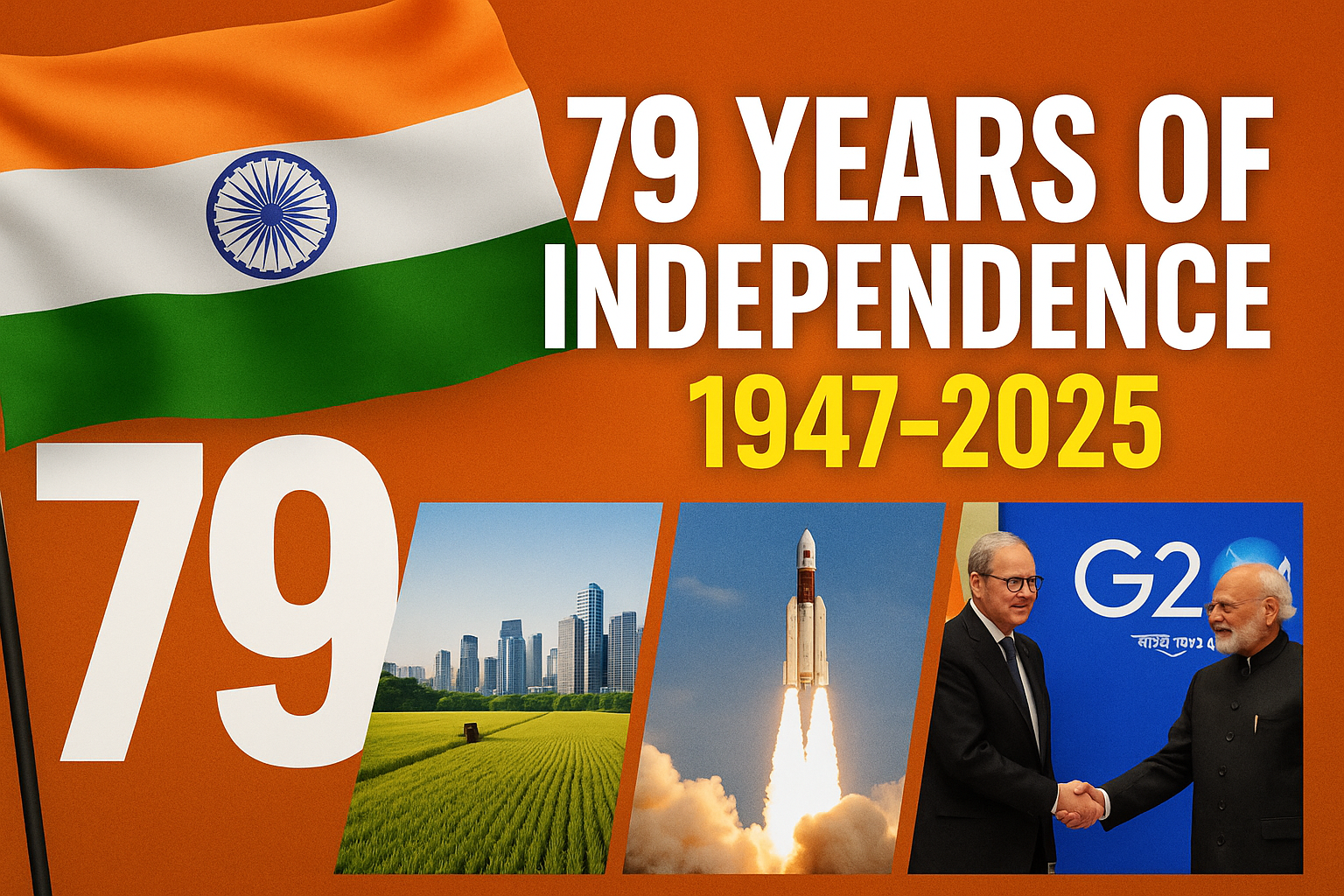
79th INDEPENDENCE DAY : What has INDIA achieved so far?
August 15 CONTEXT India gained independence from British rule on August 15, 1947, marking the beginning of a transformative journey from a colonized nation grappling with poverty, partition trauma, and economic fragility to a global powerhouse. Over the past 79 years (up to August 2025), India has made remarkable strides across multiple sectors, overcoming challenges like famines, wars, and internal conflicts while building a vibrant democracy. Key milestones include economic growth, scientific advancements, social...
Comments
Write Comment