CONTEXT
India gained independence from British rule on August 15, 1947, marking the beginning of a transformative journey from a colonized nation grappling with poverty, partition trauma, and economic fragility to a global powerhouse.
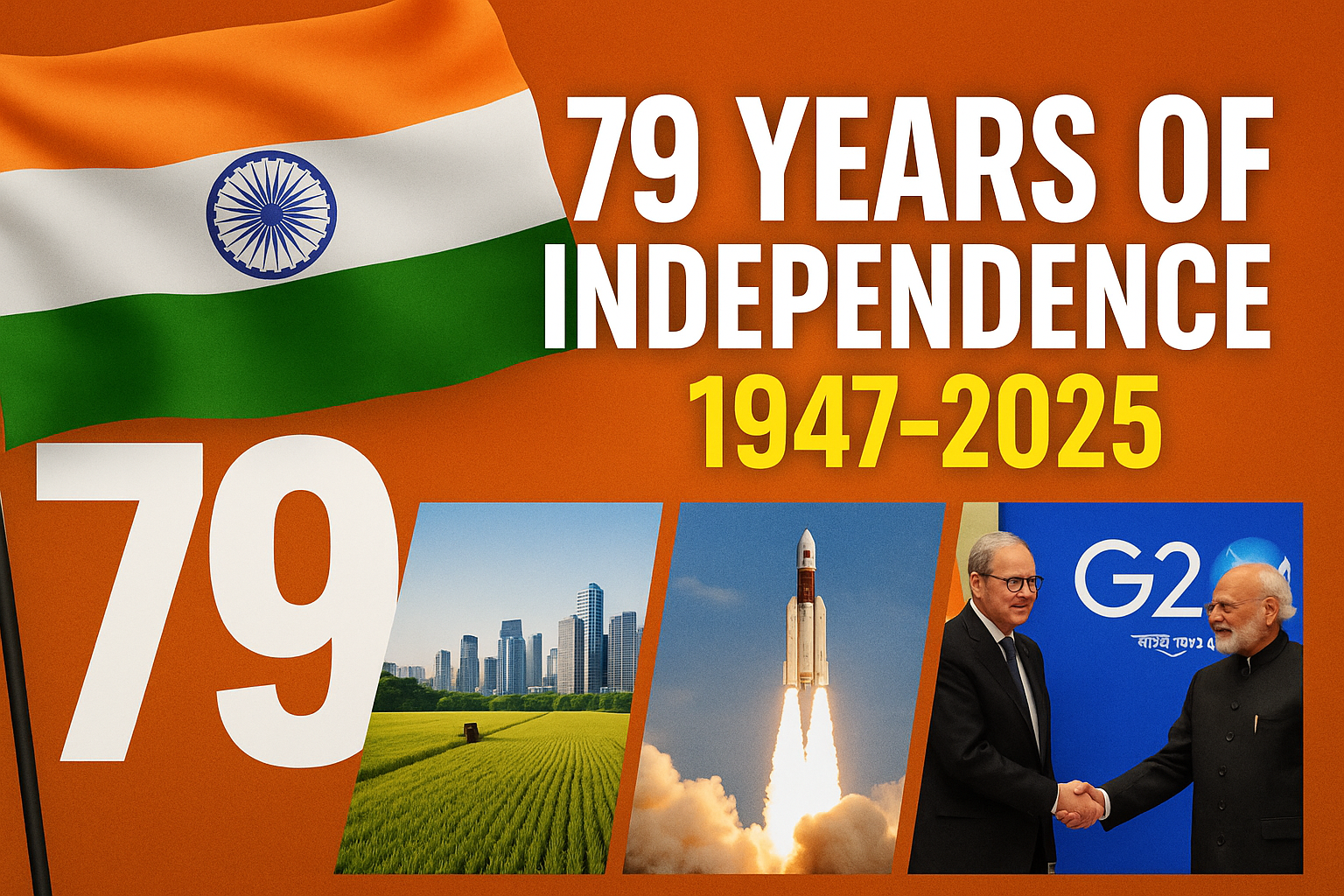
Over the past 79 years (up to August 2025), India has made remarkable strides across multiple sectors, overcoming challenges like famines, wars, and internal conflicts while building a vibrant democracy. Key milestones include economic growth, scientific advancements, social reforms, and international influence.
Economic Growth and Development
- India's economy has evolved from a GDP of about Rs. 2.7 lakh crore in 1947—marked by low industrial base and dependence on agriculture—to becoming the world's fifth-largest economy by 2025, with a GDP exceeding 350 lakh crore or $4.3 trillion.
- Green Revolution (1960s-1970s): Transformed India from a food-scarce nation to a self-sufficient agricultural powerhouse through high-yield seeds, fertilizers, and irrigation, averting famines and boosting exports.
- Economic Liberalization (1991): Reforms taken opened markets, attracting foreign investment and spurring growth rates above 7% annually in recent decades. Today India is one of the most attractive markets for FDI.
- Manufacturing and Initiatives: Programs like 'Make in India' and the Production-Linked Incentive (PLI) scheme have boosted manufacturing, with India becoming a hub for electronics, automobiles, and pharmaceuticals. India today has one of the biggest Mobile manufacturing plants of apple from where billions of dollars of mobiles are exported.
- Digital Economy: Launch of Aadhaar (world's largest biometric ID system) in 2009 and Unified Payments Interface (UPI) in 2016, has revolutionized financial inclusion, with over 1.3 billion Aadhaar cards issued and 1800 crore UPI transactions handling billions of transactions monthly. From a backward economy, India is now of the most digitally connected economy.
- Poverty Reduction: Extreme poverty dropped from over 50% in 1947 to around 10-15% by 2025, with improvements in per capita income and reductions in infant mortality.
Science, Technology, and Space Exploration
- India has emerged as a leader in innovation, with investments in R&D yielding global breakthroughs. In the Space Program, from Aryabhata (1975), the First Indian satellite to Mangalyaan (2014) which was the first Asian country to reach Mars in first attempt. Then Chandrayaan-3 (2023) which was the first to land near Moon’s south pole to Gaganyaan Mission (2025) which is the first Indian crewed spaceflight is in progress.
- IT and Software Revolution: From the 1990s, India became the "IT capital of the world," with companies like Infosys and TCS driving a $250 billion industry, employing millions and contributing to global tech (e.g., Y2K solutions, app development).
- Nuclear and Defense Tech: Pokhran nuclear tests (1974 and 1998) established India as a nuclear power. Indigenous developments include Agni missiles, Tejas fighter jets, and the Arihant submarine.
- Renewable Energy: India leads in solar power with 100 GW of installed capacity with initiatives like the International Solar Alliance (co-founded in 2015) and aims for 500 GW renewable capacity by 2030.
- Other Innovations: Electronic voting machines (EVMs) introduced in 1982 for fair elections; advancements in biotech, including COVID-19 vaccines like Covaxin. India is now known as the pharmacy of the world. It is world's biggest Vaccine producer.
Social and Political Milestones
- It has a robust Constitution Enacted in 1950, guaranteeing fundamental rights and a federal structure. India was able to successful integrate 565 princely states post-1947. As the world's largest democracy, India has focused on inclusive governance and social justice. It is world’s Largest Democracy having peaceful transfer of power through 17 Lok Sabha elections. Despite so many differences, it has maintained national integrity despite vast cultural, linguistic, and religious diversity.
- Healthcare and Education: Life expectancy rose from 32 years in 1947 to over 72 by 2025. Eradication of polio (2014) and smallpox (1975) took place and the literacy rate increased from 18% to 77%.
- Women's Rights and Social Reforms: Women's suffrage from day one; landmark laws like the Hindu Code Bill (1950s) for gender equality; schemes like Beti Bachao Beti Padhao for girl child empowerment.
- Infrastructure: Expanded railways (world's fourth-largest network), highways (e.g., Bharat Mala and Golden Quadrilateral), and metro systems in multiple cities; electrification of nearly all villages by 2019.
Sports, Culture, and Global Influence
- Sports: Won multiple Cricket World Cups (1983, 2011, 2023 T20); Olympic medals increasing, with highs in Tokyo 2020 (7 medals) and Paris 2024; hockey dominance in early years.
- Cinema and Culture: Bollywood as a global soft power; Indian diaspora influencing worldwide (e.g., CEOs like Sundar Pichai, Satya Nadella).
- International Role: Founder of Non-Aligned Movement (1961); peacekeeping contributions to UN; G20 presidency in 2023; advocacy for global south in climate and trade forums.
These accomplishments reflect India's resilience and ambition, though challenges like inequality and climate change persist. As the most populous nation since 2023, India's story inspires global democracy and development. But it has it's own issues as well.
ISSUES
Economic Challenges
- India's economy has grown rapidly, but uneven distribution of benefits, structural inefficiencies, and external vulnerabilities remain key hurdles. Income and Wealth Inequality: Inequality has widened to historic highs, with the top 10% holding 57% of national income and 64.6% of wealth in 2021, while the bottom 50% controls just 13% of income and 5.9% of wealth (Gini coefficient at 0.250 in 2025).
- Unemployment and Jobless Growth: Despite 6-7% annual GDP growth, employment elasticity has declined, leading to "job-loss growth" post-2015. Youth unemployment stands at 15-16.8%, with 10-12 million entering the workforce annually but limited formal jobs (90% in informal sector). Urban unemployment for females has improved but remains high overall at 9% in FY24/25.
- Agrarian Distress and Rural Economy: Agriculture employs 45% of the workforce but contributes only 16% to GDP, with rising landlessness (8.2% of households in 2018-2019), marginal holdings (76.5%), and inadequate returns below Minimum Support Prices. Input costs like rentals (28% of cultivation) and debt trap farmers.
- Manufacturing Stagnation and Trade Issues: Manufacturing's GDP share hovers at 13-18%, declining due to premature deindustrialization and protectionist policies (high tariffs, low 1.8% global trade share). Global trade tensions and escalating barriers could slow growth to 6.5% in 2025.
- Inflation and External Vulnerabilities: Food inflation over 8%, oil dependency, and rupee volatility strain imports (85% oil dependency) and balance of payments. Policy disruptions like demonetization (2016) and GST (2017) caused employment losses of 23-38% in MSMEs.
Social Challenges
- Education and Healthcare Deficits: Low public spending (2.9% GDP on education, 2.1% on health) leads to poor outcomes; 25% of 14-18-year-olds can't read fluently, and Inequality-adjusted HDI shows a 31.1% loss due to disparities. Only 10% of the workforce is skilled, vs. 60% in developed nations.
- Gender and Social Vulnerabilities: Gender gaps persist in employment and education.
Political and Governance Challenges
- Corruption, Instability, and Conflicts: Religious violence, Naxalism, terrorism, separatist insurgencies, and territorial disputes (e.g., with China) persist. Public discontent over corruption and political hesitation on reforms (land, labor) stall progress.
- Democracy and Institutional Weaknesses: Challenges include weak institutions, governance deficits, and policy uncertainty amid global discord.
Environmental Challenges
- Environmental degradation threatens sustainability and exacerbates other issues. Climate Change and Natural Disasters: Erratic monsoons, droughts, and extreme weather impact agriculture (rain-fed in many areas) and food security. India aims for net-zero by 2070 but faces rising risks from trade tensions and disasters.
- Water Scarcity and Pollution: Over 4 million in cities like Bengaluru need better water security; pollution and resource strain persist despite initiatives.
- Energy and Sustainability Gaps: High oil import dependency and low renewable integration amid global energy disruptions.
- Other Persistent Issues
- Infrastructure and Urbanization Gaps: Despite improvements, deficits in roads, power, and urban planning hinder growth.
- Global Integration and Geopolitical Risks: Low FDI (0.8% GDP in 2023), protectionism, and U.S. policy shifts (e.g., tariffs) pose external threats.
So India has a mixed bag of achievements and failures. Addressing these requires inclusive policies, higher investments in human capital (e.g., education/health at OECD levels), and reforms in labor/agriculture. With focused efforts, India can leverage its demographic and digital strengths for equitable growth.



Comments
Write Comment