| Term | Full Form | What it Means | Typical Depth of Market Access |
|---|---|---|---|
| PTA | Preferential Trade Agreement | Two or more countries agree to reduce import duties on a limited number of products. Not a full free trade pact; tariffs are just partially lowered and only for some goods. | Low — only certain tariff lines get concessions. |
| FTA | Free Trade Agreement | Countries eliminate or reduce tariffs and quotas on most goods traded between them. Services and investment may be included, but depth varies. | Medium — most goods duty-free, some services, moderate rules. |
| CECA | Comprehensive Economic Cooperation Agreement | Goes beyond an FTA: covers goods, services, investments, intellectual property, and sometimes government procurement. Usually includes a roadmap for deeper cooperation. | High — trade + services + investment + regulatory cooperation. |
| CEPA | Comprehensive Economic Partnership Agreement | Similar to CECA but often broader and deeper; adds dispute resolution, competition policy, e-commerce, technical standards. Usually indicates strategic economic partnership. | Very high — deepest integration after customs/economic union. |
| Feature / Aspect | PTA – Preferential Trade Agreement | FTA – Free Trade Agreement | CECA – Comprehensive Economic Cooperation Agreement | CEPA – Comprehensive Economic Partnership Agreement |
|---|---|---|---|---|
| Main Objective | Limited tariff concessions on selected products | Eliminate/reduce tariffs on most goods | FTA + deep cooperation on services & investment | CECA + regulatory, legal, digital & strategic partnership |
| Tariff Coverage | Small list of products (5–20% of tariff lines) | Broad (70–90% goods duty-free over time) | Very broad (>90% goods duty-free) | Nearly full goods liberalisation |
| Services & Investment | ❌ Usually excluded | ⚠️ Optional / limited | ✅ Included (market access + investment protection) | ✅ Deeper + e-commerce, IP, competition policy |
| IP / Digital Trade / Standards | ❌ | ❌ / very limited | ⚠️ Partial | ✅ Usually included |
| Dispute Resolution | Not formalised | Basic WTO-style | Detailed | Detailed & binding (arbitration panels, etc.) |
| Strategic Signalling | Minimal (purely trade) | Moderate | Stronger — long-term economic link | Very strong — “strategic economic alliance” |
| Examples (India) | India–MERCOSUR PTA, India–Afghanistan PTA | India–ASEAN FTA, India–Sri Lanka FTA | India–Singapore CECA, India–Malaysia CECA | India–Japan CEPA, India–South Korea CEPA, India–UAE CEPA |
| Partner / Bloc | Type | Signed | Key Highlights |
|---|---|---|---|
| Japan | CEPA | 2011 | Eliminated tariffs on ~94% of trade. Covers goods, services, investments, IPR. |
| South Korea | CEPA | 2009 (upgraded 2017) | Large tariff cuts, investment & services opening. India-Korea trade over $27 bn (2024). |
| Singapore | CECA | 2005 | Covers goods, services, investment. Singapore became a big FDI source for India. |
| Malaysia | CECA | 2011 | Deep cuts on palm oil, electronics; services commitments. |
| UAE | CEPA | 2022 | Eliminated duties on ~80% tariff lines, big push for gems, gold, textiles; India-UAE trade >$85 bn. |
| Mauritius | CECPA | 2021 | Covers ~310 Indian goods duty-free; first African CECPA for India. |
| Australia | ECTA (Interim CECA) | 2022 | Eliminated tariffs on 85% Indian exports (textiles, gems); full CECA under negotiation. |
| Partner / Bloc | Type | Signed | Key Highlights |
|---|---|---|---|
| ASEAN (10 nations) | FTA in Goods | 2009 (services 2014) | Duty cuts on 80% tariff lines; big for palm oil, electronics. |
| SAFTA (SAARC) | FTA | 2006 | Covers South Asian countries; partial liberalisation. |
| India–Chile | PTA (expanded 2016) | — | Covers ~2,000 products with reduced duty. |
| India–Nepal | FTA (bilateral trade treaty) | 2009 renewal | Duty-free access for most goods; special economic cooperation. |
| India–Bhutan | FTA | 2006 update | Duty-free bilateral trade; hydropower key. |
| India–Sri Lanka | FTA | 2000 | Duty-free for over 4,000 products; services upgrade stalled. |
| India–Thailand | Early Harvest (towards FTA) | 2004 | Duty cuts on 82 items; full FTA under discussion. |
| Partner / Bloc | Type | Signed |
|---|---|---|
| MERCOSUR (Brazil, Argentina, Uruguay, Paraguay) | PTA | 2004 (expanded 2017) |
| Afghanistan | PTA | 2003 |
| Chile | PTA | 2006 (expanded 2016) |
A Bilateral Investment Treaty (BIT) is an agreement between two countries that sets out the rules and protections for investors from each country when they invest in the other country.
It is meant to encourage foreign investment by giving investors legal certainty and protection.
| Feature | BIT (Bilateral Investment Treaty) | TRIMs (Trade-Related Investment Measures) |
|---|---|---|
| Nature | A treaty signed between two countries to protect and promote cross-border investment. | A multilateral WTO agreement that disciplines certain investment measures affecting trade. |
| Part of | International investment law (stand-alone agreement between two states). | Part of the WTO system (Annex 1A of WTO Agreement). |
| Main Goal | Protect foreign investors and give legal certainty. | Prevent governments from using trade-distorting conditions on foreign investors. |
| Focus | Rights & protections for investors (fair & equitable treatment, protection against expropriation, dispute settlement). | Limits on host country’s investment rules that restrict free trade (e.g., local content requirement). |
| Coverage | Wide: covers admission, treatment, protection, and transfer of investments. | Narrow: only investment measures that affect trade in goods and violate GATT principles. |
| Dispute Resolution | Usually includes Investor-State Dispute Settlement (ISDS) — investor can sue host country in international arbitration. | Only state-to-state dispute settlement at the WTO (companies cannot sue directly). |
| Example | India–UAE BIT (2013), India–UK BIT. | TRIMs Agreement prohibits: ① Local content requirement (must use X% local inputs) ② Trade balancing requirement (limit imports to value of exports). |

Ask Anything, Know Better
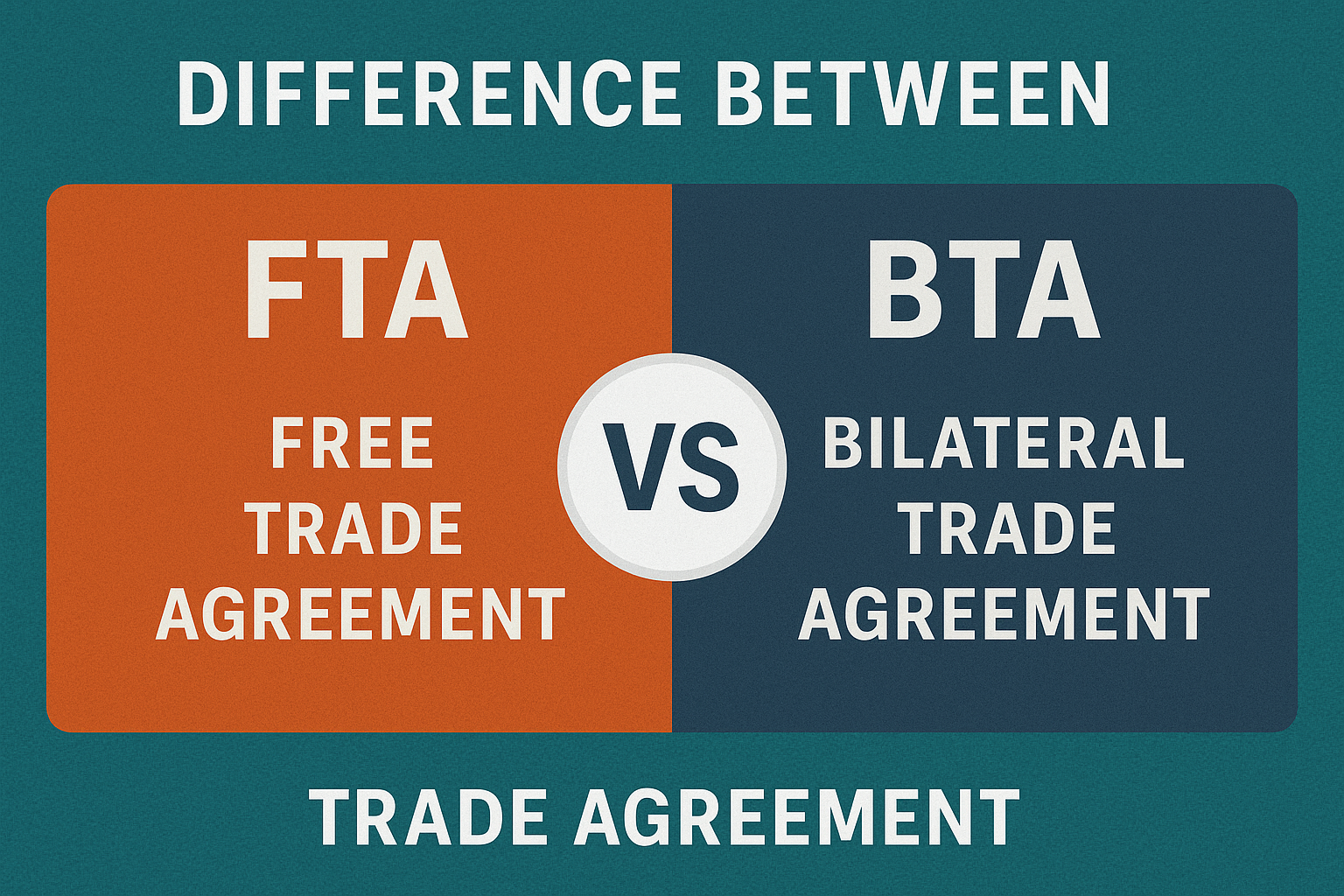
July 23 WHAT? The terms Free Trade Agreement (FTA) and Bilateral Trade Agreement (BTA) are often used in the context of international trade, but they have distinct meanings and implications. Below is a clear explanation of the differences based on their definitions, scope, and application. Free Trade Agreement (FTA) An FTA is a treaty between two or more countries to reduce or eliminate trade barriers, such as tariffs and quotas, to facilitate the free flow of goods and services. FTAs aim to create a free trade...
July 19 Trade-Related Investment Measures (TRIMs) are a set of rules laid down by the World Trade Organisation that controls certain investment-related measures that may impact global trade. These investment-related measures can have trade-restrictive and distorting effects. Under TRIMS, WTO names the list of investment measures which member countries adopt and that discriminates with the foreign investment when compared to domestic ones and hence violate the basic WTO principle of National Treatment. National treatment demands that...

Comments
Write Comment