Have you ever wondered how we measure a country's economy? We use GDP, or Gross Domestic Product, which shows the total value of goods and services made in the whole country. But what if we zoom into smaller areas, like districts? That's where District Domestic Product (DDP) comes in. It's like GDP but for each district in a state or country. In India, DDP is gaining attention as a way to understand local economies better. This article explains what DDP is, if it's coming soon, its benefits, and why it matters—all in simple English.
DDP measures the total value of all goods and services produced in a single district over a year. Imagine India’s economy as a big pyramid built from the ground up. At the base of this pyramid lies the District Domestic Product (DDP) — the foundation where the real economy begins. DDP measures the total value of goods and services produced within a single district in a year.
It shows how strong or weak a district’s economy is, based on activities like farming, industries, or services. For example, agriculture in Punjab, diamond polishing in Surat, or IT services in Bengaluru — all add to their respective districts’ DDP. When we add up all the DDPs within a state, we get the Gross State Domestic Product (GSDP), which represents the total economic output of that state.
GSDP helps compare states and plan budgets or policies according to their economic performance — for instance, Maharashtra’s GSDP is larger than Bihar’s, indicating greater production and industrial activity.
At the top of the pyramid is the Gross Domestic Product (GDP) — the total value of all goods and services produced in the entire country. When we combine every state’s GSDP, we get India’s GDP, which reflects the overall size and strength of the national economy.
In simple words, each district’s DDP contributes to its state’s GSDP, and all states’ GSDPs together form the country’s GDP. This pyramid structure shows that India’s economic growth begins from the grassroots — the districts — and moves upward. If district economies are strong, states prosper; and when states prosper, the nation’s GDP grows. Thus, DDP is the foundation on which India’s entire economic pyramid stands.
DDP isn't entirely new—some states like Uttar Pradesh have been calculating it for a few years. But better, more detailed DDP estimates are on the way. As of early 2025, the Indian government started using new surveys to make DDP more precise.
The Ministry of Statistics and Programme Implementation (MoSPI) is teaming up with states to use data from the Annual Survey of Unincorporated Sector Enterprises (ASUSE) and the Periodic Labour Force Survey (PLFS). ASUSE looks at small businesses and households, while PLFS checks employment and income trends. This "bottom-up" approach started from January 2025, with pilots already running. More surveys, like one on household income, will help fill gaps soon.
In Uttar Pradesh, they've added 50 new indicators to their DDP calculations, making a total of 76 for the 2023-2024 estimates. This includes things like GST (Goods and Services Tax) from beauty parlors or entertainment, showing real trends in districts. So, while DDP is here in parts, nationwide improvements are happening now, not just "coming soon"—they're already rolling out as of 2025.
In Uttar Pradesh, the new District Domestic Product (DDP) indicators reveal some very interesting economic trends for the year 2023–2024. For instance, beauty and grooming-related spending, measured through GST collected from parlors, showed that Gautam Budh Nagar (Noida) led the state with ₹11.21 crore, marking a 38% increase compared to the previous year.
This rise indicates that urban areas like Noida are witnessing a growing focus on personal grooming and lifestyle services. Similarly, when it comes to entertainment spending, Lucknow topped the list with ₹24.5 crore collected as entertainment GST, reflecting a 70% jump, while Noida saw an even more dramatic 137% surge.
These numbers highlight a clear shift in urban lifestyles, where people are spending more on leisure, entertainment, and comfort. Such trends are valuable for policymakers, as they help districts identify which sectors are expanding and encourage the growth of more formal businesses—those registered under GST—to increase both local revenue and overall economic development.
Data Quality Issues: Collecting accurate and updated economic data at the district level is difficult, as surveys are often delayed or inconsistent.
Lack of Skilled Workforce: Many districts lack trained professionals who can correctly estimate and analyze DDP figures.
Need for Digital Tools: Using digital platforms and technology for data collection can greatly improve accuracy and speed.
Fair and Balanced Growth: A reliable DDP helps ensure that every district gets equal focus and development opportunities — no region is left behind.
Support for Viksit Bharat 2047: DDP strengthens fiscal federalism by giving more economic power to local areas, making it a vital step toward India’s goal of becoming a developed nation by 2047.
District Domestic Product (DDP) is already making waves in India, with enhanced estimates starting in 2025 using new surveys like ASUSE and PLFS. It's not just "coming soon"—it's here and improving. The benefits are huge: from smarter policies and reduced gaps to spotting local trends. If you're interested in how India's economy works at the grassroots, keep an eye on DDP—it's set to change how we plan for a brighter future.

Ask Anything, Know Better
October 02 WHAT? Gross Domestic Product (GDP) is the total monetary value of all final goods and services produced within a country’s borders during a specific period — usually a quarter or a year. It measures the size and health of an economy and is widely used to compare countries, track economic progress, and guide government policy. “Gross” → calculated before deducting depreciation of machines, buildings, and other capital goods. “Domestic” → includes production by anyone within the...
September 19
September 09 Tax Buoyancy Tax buoyancy tracks the percentage change in tax revenue against a 1% change in nominal GDP. It reflects the change in the Tax collection with the change in the national income or the GDP. Formula: Tax Buoyancy = (% Change in Tax Revenue) / (% Change in Nominal GDP) A buoyancy of 1 implies revenues match GDP growth; above 1 signals a robust system (e.g., via aggressive reforms); below 1 warns of leakages, evasion, or structural weaknesses. In India, post-2017 GST, buoyancy for direct taxes has...
September 01

June 04 WHAT? The Purchasing Managers' Index (PMI) is an economic indicator derived from monthly surveys of private sector companies. It reflects the prevailing direction of economic trends in manufacturing and services sectors. Who publishes PMI in India? Compiled by: S&P Global (formerly IHS Markit) Published for India by: S&P Global Not released by government bodies like MOSPI or RBI Types of PMI in India PMI Type Sector...
June 03 SUMMARY The article "Towards an Indian Growth Model" from The Hindu Business Line advocates for a development strategy tailored to India's unique strengths and challenges, moving beyond traditional Western economic models. Key points include Domestic Demand-Driven Growth: India's economy has been significantly propelled by domestic consumption, accounting for 64% of its GDP, surpassing figures in Europe, Japan, and China. This consumption-led approach has fostered a robust middle...
May 31 SUMMARY India has officially overtaken Japan to become the world's fourth-largest economy, marking a significant milestone in its economic ascent. Key Highlights GDP Milestone: India's nominal GDP has reached approximately $4.187 trillion for the fiscal year 2025–26, slightly surpassing Japan's $4.186 trillion, according to IMF projections. Rapid Growth: In the January–March 2025 quarter, India's economy grew by 7.4% year-on-year, exceeding expectations and...
May 30 SUMMARY India's GDP growth for the fourth quarter of FY2024–25 is projected to be around 7%, driven by robust rural demand, increased government spending, and improved agricultural output. However, the full fiscal year growth is expected to settle at approximately 6.3%, slightly below earlier estimates. Q4 FY2024–25 Growth Estimates Reuters projects 6.7% growth, citing stronger rural consumption and state expenditure, despite subdued private investment. ICRA estimates...
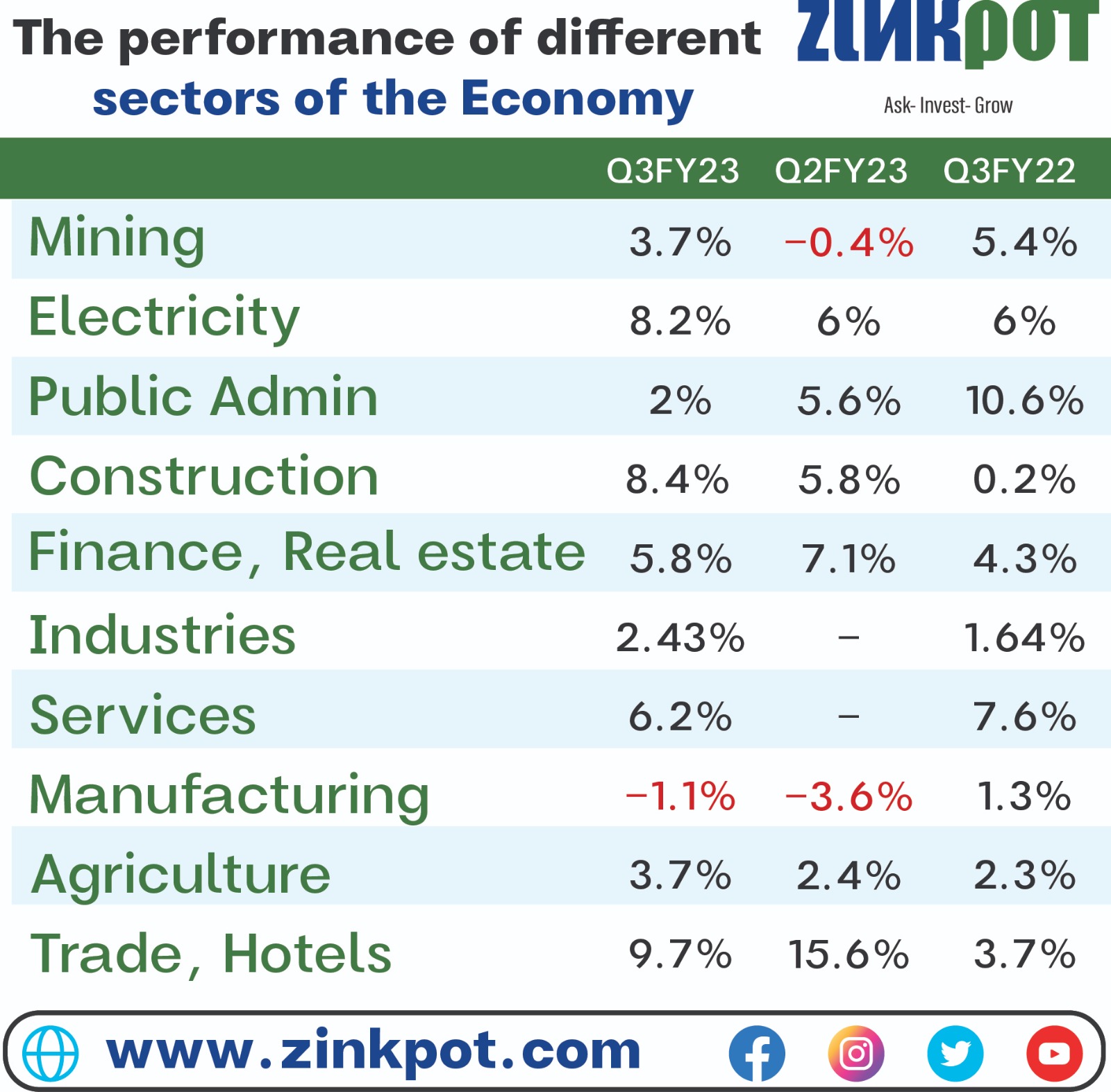
March 03 As per the recent reports, Q3 of FY 2022-23 has experienced lower growth rate than the previous quarters. GST collection is also 5% lower in February than in January. Look at the catalogues for more details.

Comments
Write Comment