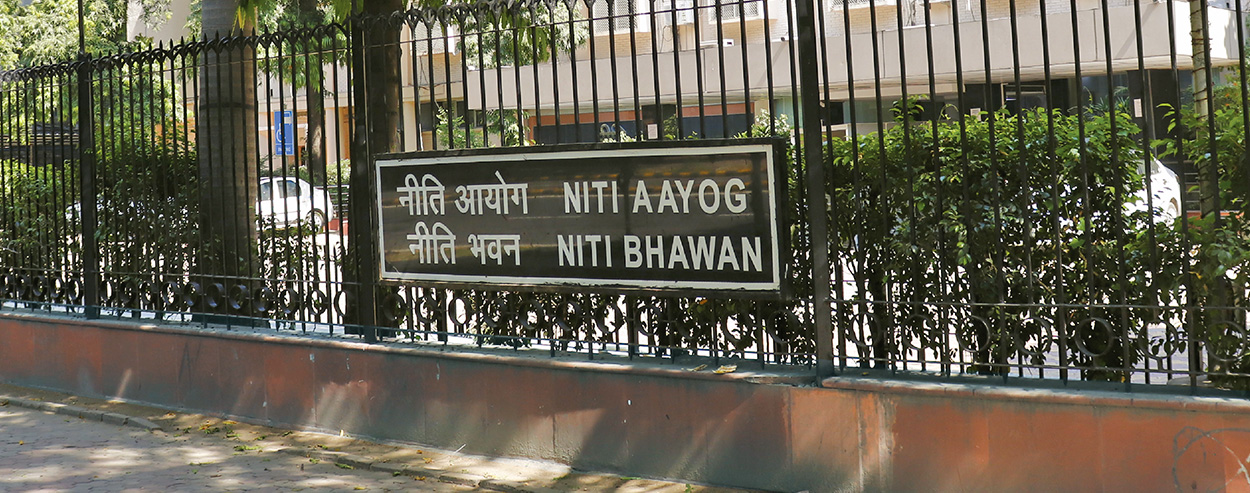
NITI Aayog, where NITI stands for ‘National Institution for Transforming India', was formed on January 1, 2015. It is the premier policy ‘Think Tank’ of the Government of India. It was formed by scrapping the 65-year-old Planning Commission. It is neither a constitutional body nor a statutory body. In other words, it is a non-constitutional or extra-constitutional body (i.e. not created by the Constitution) and a non-statutory body (not created by an act of the Parliament).
Roles and Functions
- NITI Aayog functions as a platform for strategic planning, policy advice, and monitoring of government initiatives. Key roles include:
- Developing long-term strategies for economic growth and poverty alleviation.
- Advising on resource allocation and fostering innovation in sectors like technology, agriculture, and infrastructure.
- Monitoring and evaluating the implementation of programs across states.
- Promoting research and best practices through partnerships with global experts.
The composition of the Niti Aayog
- Chairperson: The Prime Minister of India
- Governing Council: It comprises the Chief Minister of all the States, Union Territories with legislatures (i.e. Delhi, Puducherry, and Jammu and Kashmir) and Lt. Governors of other Union Territories.
- Regional Councils: These are formed to address specific issues and contingencies impacting more than one state or region. They are found for a specified tenure and are convened by the Prime Minister.
- Special Invitees: Exports, specialists, and practitioners with relevant domain knowledge as special invitees are nominated by the Prime Minister.
- Full-time Organisational Framework: It comprises, in addition to the PM as the Chairperson:
- Vice Chairperson: He/she is appointed by the Prime Minister.
- Full-time members: They enjoy the rank of a Minister of State.
- Part-time members: Maximum of 2 members from foremost universities, leading research organizations, and other innovative organizations in an ex-officio capacity. Part-time members will be on a rotational basis.
- Ex-officio Members: Maximum of 4 members of the Union Council of Ministers to be nominated by the Prime Minister.
- Chief Executive Officer: He/she is appointed by the Prime Minister for a fixed tenure, in the rank of Secretary to the Government of India.
- Secretariat: As deemed necessary.
NITI Aayog’s entire gamut of activities is divided into two main hubs: Team India and Knowledge and Innovation
- The Team India Hub carries out the mandate of fostering cooperative federalism and designing policy and program frameworks. It provides requisite coordination and support in NITI Aayog’s engagement with States.
- The Knowledge and Innovation Hub maintains a state-of-the-art resource center, a repository of research on good governance and best practices, provides advice and encourages partnerships with key stakeholders including colleges, universities, think tanks, and non-governmental organizations at home and abroad.
The various functions performed by the Niti Aayog can be divided into four main heads
- Policy and Programme Framework: NITI Aayog formulates long-term strategic plans and provides technical advice to the central and state governments.
- Cooperative and Competitive Federalism: Niti Aayog has been constituted to actualize the important goal of cooperative federalism. On the premise that strong states make a strong nation, Niti Aayog acts as the quintessential platform for the government of India by bringing the states together and working towards the National Development Agenda.
- Monitoring and Evaluation: It actively monitors and evaluates the implementation of programs and initiatives including the identification of the necessary resources to strengthen the probability of success and scope of delivery.
- Think Tank and Knowledge Hub: NITI Aayog serves as a state-of-the-art resource center, promoting research, and innovation, and providing strategic policy vision for the government.
In addition to these functions, NITI Aayog also focuses on technology upgradation, capacity building, and the identification of resources to strengthen the probability of success. It aims to play a vital role in India's development process and is supported by various verticals, cells, and autonomous bodies to provide coordination and support.


Comments
Write Comment