WHAT?
Gross Domestic Product (GDP) is the total monetary value of all final goods and services produced within a country’s borders during a specific period — usually a quarter or a year. It measures the size and health of an economy and is widely used to compare countries, track economic progress, and guide government policy.
“Gross” → calculated before deducting depreciation of machines, buildings, and other capital goods.
“Domestic” → includes production by anyone within the country (citizens or foreign-owned companies).
“Product” → counts only final goods & services to avoid double counting of intermediate goods.
Key Features of GDP
- Time-bound: Always tied to a specific period (quarterly or yearly).
- Location-based: Measures production inside national borders, no matter who owns the firm.
- Market Value: Expressed in money terms so that varied goods & services can be summed.
- Excludes Non-Market Work: Unpaid household work or informal barter is not fully captured.
- Indicator, Not Perfect: Shows production and income but not well-being or inequality.
Related terms
| Type |
Meaning |
Why It Matters |
| Nominal GDP |
Value of goods & services at current market prices |
Shows raw economic size but includes inflation |
| Real GDP |
Adjusted for inflation using base-year prices |
Best for tracking true growth over time |
| GDP per Capita |
GDP ÷ Population |
Reflects average income/output per person |
| PPP-based GDP |
Adjusted for price level differences across countries |
Useful for comparing purchasing power internationally |
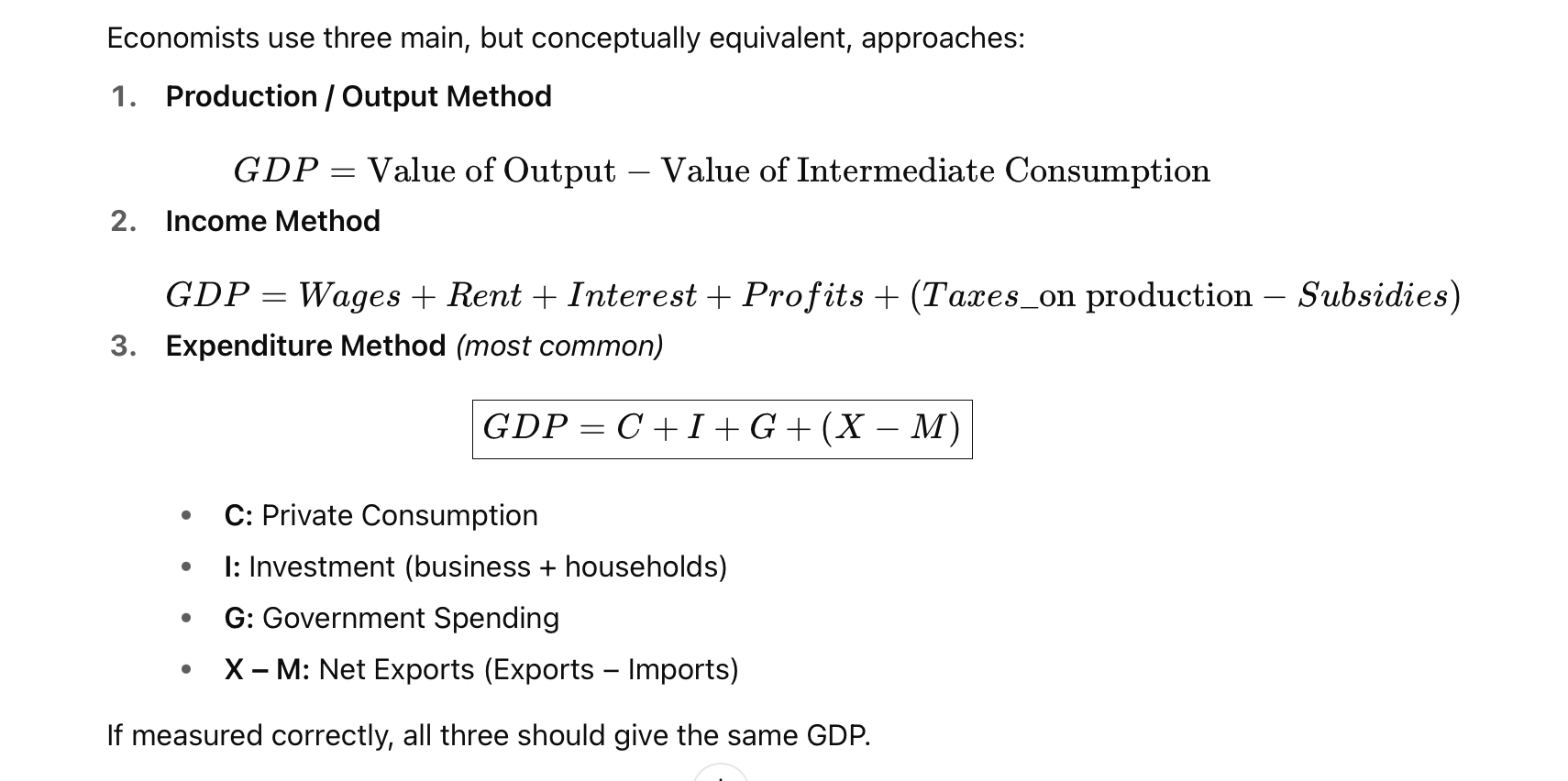
How GDP Is Measured
 Nominal vs. Real GDP
- Nominal GDP – at current prices; includes inflation.
- Real GDP – adjusted for inflation; better for comparing growth across years.
- GDP Deflator = Nominal GDP ÷ Real GDP × 100 → shows overall price change in the economy.
Why GDP Matters
- Health Check of Economy: High growth suggests expansion; low or negative means slowdown.
- Policy Planning: Governments and central banks (like the RBI) base fiscal and monetary policies on GDP trends.
- Global Ranking: Determines a nation’s economic power and investment attractiveness.
- Budget Ratios: Fiscal deficit or public debt are often compared to GDP.
- Business Decisions: Companies track GDP to plan expansion, hiring, and product launches.
Limitations of GDP
- Ignores inequality: GDP can rise even if the rich get richer but poor don’t benefit.
- Excludes unpaid & informal work: Large informal economies (like in India) are undercounted.
- No environmental accounting: Pollution and resource depletion are not deducted.
- Not a happiness or welfare metric: Doesn’t measure life satisfaction or health directly.
- Subject to revisions: Initial estimates often change when better data arrives.
India's GDP
for FY 2024-25, India's GDP stood at 331 lakh crore which translated to 4.3 trillion dollars. India's GDP has been fastest in the world with the following growth rates
Q2 2025 (Apr–Jun): +7.8% year-on-year
Q1 2025 (Jan–Mar): +7.4% year-on-year
FY 2024–25 overall: ~ 6.5% growth
IMF forecast for 2025: 6.4% — one of the fastest among major economies.
Sectoral Breakdown
- Services: Largest contributor — IT, finance, trade, tourism.
- Industry & Manufacturing: Rising with Make in India and PLI schemes.
- Agriculture: Still employs ~40% of workforce but contributes <20% of GDP (low productivity).


Comments
Write Comment